WELCOME TO
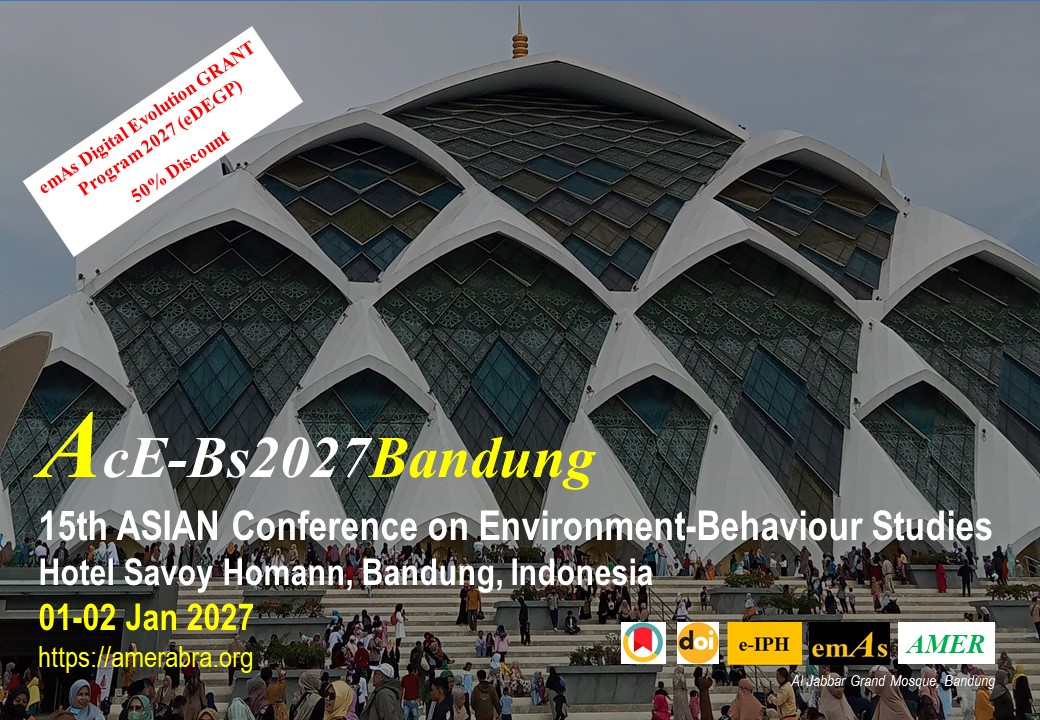
Our 56th international conference, the hybrid AcE-Bs2027Bandung (15th ASIAN Conference on Environment-Behaviour Studies
Organiser

Managed by

Venue

Hotel Savoy Homann, Bandung, Indonesia
ABOUT THE CONFERENCE
The hybrid AcE-Bs2027Bandung (15th Asian Conference on Environment-Behaviour Studies) is a peer-reviewed international scientific conference organised by the Association of Malaysian Environment-Behaviour Researchers (AMER). Serving as the curtain raiser for AMER’s 56th international conference event, it forms part of AMER’s continuing international programme in Environment-Behaviour Studies. Managed by emAs (AMER Event Management & Services), Malaysia, the conference will be held at Hotel Savoy Homann, Bandung, Indonesia, on 01–02 January 2027.
As an Asian conference on Environment-Behaviour Studies (EBS), AcE-Bs2027Bandung focuses on relationships between people, behaviour, and the environmental conditions in which individuals and communities live, interact, work, learn, and experience everyday life. It provides a scholarly platform for researchers, academics, and practitioners to investigate the physical, social, cultural, urban, architectural, technological, and ecological dimensions of human-environment relationships across diverse Asian societies and communities.
The conference welcomes research addressing Asian cities, communities, cultures, settlements, institutions, built environments, natural environments, and sociocultural settings. Comparative studies across Asian countries and research connecting Asian contexts with wider international perspectives are also encouraged where they contribute substantively to understanding environment-behaviour relationships.
AcE-Bs2027Bandung forms part of AMER’s continuing international conference programme in Environment-Behaviour Studies (EBS) and Environmental Psychology. It supports interdisciplinary research on human-environment relationships, environmental behaviour, spatial experience, wellbeing, quality of life, and related fields, including investigations into how environmental conditions and human activities influence one another.
Although the conference maintains an Asian regional scholarly focus, participation is open to researchers, academics, and practitioners from Asia and other regions. International participation, cross-country academic exchange, and comparative research are encouraged. International co-authorship is not a condition of scientific eligibility or publication.
The primary proceedings publication is the open-access Environment-Behaviour Proceedings Journal (E-BPJ) (eISSN 2398-4287), Volume 12, Number 39 (January 2027). Papers accepted for publication and satisfying the applicable peer-review, revision, editorial, ethical, and publication requirements will be included in the proceedings. Conference participation or presentation alone does not guarantee publication.
PURPOSE OF PARTICIPANTS CONGREGATING AT THE EVENT
AcE-Bs2027Bandung brings together researchers, academics, and spatial practitioners to provide a scholarly forum for the presentation, discussion, and critical exchange of research in Environment-Behaviour Studies and Environmental Psychology, with particular attention to environmental and behavioural issues relevant to Asian societies and communities.
The conference facilitates academic exchange through the presentation of research findings, discussion of theoretical and methodological approaches, and examination of relationships between people, behaviour, and their physical, social, cultural, technological, and natural environments across diverse Asian geographical and sociocultural contexts.
By bringing together participants from different countries, institutions, and disciplinary backgrounds, the conference encourages international academic interaction and the exchange of perspectives on environmental conditions, human behaviour, spatial experience, wellbeing, and quality of life. Comparative and cross-contextual research is welcomed where it contributes to a broader understanding of human-environment relationships in Asian settings.
The conference also provides opportunities for participants to receive scholarly feedback, explore emerging research directions, establish academic connections, and disseminate research through the applicable peer-review and publication processes.
AMER’s international conference programme encourages participation across countries and disciplines to advance scholarly dialogue in Environment-Behaviour Studies. International participation and collaboration are encouraged, but international co-authorship is not a condition of scientific eligibility or publication. Individual submissions are assessed according to their scholarly quality, originality, relevance to the conference and publication scope, methodological rigour, and compliance with applicable editorial and ethical requirements.
SCOPE SCREENING
All submissions are subject to an initial scope assessment to determine whether they fall within the conference’s stated academic scope and demonstrate a substantive relationship to Environment-Behaviour Studies, Environmental Psychology, or relevant human-environment relationships in Asian contexts.
Submissions that do not demonstrate sufficient relevance to the conference’s scientific focus may not proceed to peer review.
The six permanent research tracks provide a framework for thematic classification, programme organisation, and reviewer assignment. They are not intended to restrict interdisciplinary research, comparative studies, or other scholarly approaches that make a clear and substantive contribution to the conference’s academic focus.
Scope screening is distinct from peer review. Submissions that pass the initial assessment remain subject to the applicable scholarly evaluation, revision, editorial, and ethical requirements.
FOCUS OF THE CONFERENCE
The scientific focus of AcE-Bs2027Bandung centres on Environment-Behaviour Studies (EBS) and Environmental Psychology, with particular attention to environmental, spatial, social, cultural, urban, architectural, technological, and ecological issues in Asian contexts.
The conference provides a multidisciplinary platform for examining how people interact with, experience, and respond to their physical, social, cultural, technological, and natural environments. Contributions may investigate how environmental conditions influence human behaviour, experience, wellbeing, and quality of life, as well as how human activities, practices, and behavioural patterns shape the environments in which people live and interact.
Research concerning Asian societies, communities, cities, settlements, institutions, cultures, built environments, and ecological settings is particularly welcome. Comparative and cross-country studies involving Asian contexts are also encouraged where they advance understanding of environment-behaviour relationships or offer insights applicable across different geographical and sociocultural settings.
To maintain thematic coherence, submissions should demonstrate a clear and substantive relationship to human behaviour, spatial experience, environmental conditions, or human-environment relationships. Interdisciplinary approaches are welcome where their relevance to the conference’s scientific focus is clearly established.
All submissions should align with one of the following six permanent research tracks.
Track 1 — Smart Technology & Digital Behavioural Environments
Research concerning digital and technology-mediated environments, including digital communication, healthcare technologies, learning environments, behavioural interactions with emerging technologies, and related institutional, policy, and sociocultural dimensions.
Track 2 — Socio-Economic, Management & Public Policy Environments
Research examining socioeconomic conditions, organisational and management environments, institutional practices, public policy, professional practices, and ethics, particularly their relationships with human behaviour and environmental outcomes.
Track 3 — Built Environment, Spatial Design & Spatial Infrastructure
Research addressing relationships between people and the built environment, including architecture, urban design, spatial planning, infrastructure, housing, mixed-use environments, pedestrian experience, and spatial behaviour.
Track 4 — Social, Cultural & Community Interaction Environments
Research concerning social and cultural environments, community interaction, public spaces, creative and cultural activities, social engagement, local identity, and human interaction within shared environments.
Track 5 — Human Development, Spatial Education & Physical Wellbeing
Research examining human development, education, health, wellbeing, ageing, caregiving, physical activity, learning environments, and the spatial or environmental conditions affecting individuals and communities.
Track 6 — Sustainability, Energy, Natural Environments & Environmental Cognition
Research addressing sustainability, environmental vulnerability, energy and thermal conditions, climate adaptation, natural environments, environmental cognition, and human responses to changing ecological and environmental conditions.
PROCEEDINGS PUBLICATION AND MANUSCRIPT REQUIREMENTS
Commencing in 2027, E-BPJ will progressively transition the administration of its peer-review workflow from email-based processes to the secure, native Open Journal Systems (OJS) platform. This transition is intended to strengthen the documentation and traceability of editorial decisions, reviewer assignments, review reports, author revisions, and publication-related activities, supporting the journal’s editorial governance and future indexing evaluations.
To support this transition, emAs Digital Evolution Grant Program (eDEGP) will provide a 50% subsidy on conference registration fees and publication fees for eligible manuscripts submitted to AcE-Bs2027Bandung, subject to the programme’s applicable terms and conditions. The subsidy supports the transition to the OJS workflow and does not constitute a guarantee of peer-review acceptance or publication.
Papers accepted for publication following the applicable peer-review, revision, editorial, and ethical procedures will be included in the Environment-Behaviour Proceedings Journal (E-BPJ) (eISSN 2398-4287), Volume 12, Number 39 (January 2027).
Authors must prepare their final manuscripts in accordance with the applicable conference template and publication instructions. Required scholarly and bibliographic elements include the paper title, abstract, author names, institutional affiliations, keywords, main text, and cited references.
Authors are responsible for ensuring that author details, affiliations, references, and other bibliographic information are accurate and complete. Manuscripts that do not comply with the applicable final publication requirements may be returned for correction before production.
Published papers are assigned Crossref Digital Object Identifiers (DOIs), subject to successful registration. Bibliographic information and article metadata form part of the journal’s official publication record. Publication remains subject to completion of the applicable editorial, ethical, production, and registration requirements.
INDEXING AND DISCOVERABILITY
E-BPJ content and bibliographic metadata are discoverable through scholarly information and discovery services, including Google Scholar, Scilit, and WorldCat. Bibliographic metadata and DOI registration information are also available through Crossref.
Coverage and discoverability are subject to the collection policies, technical processes, and indexing practices of each individual service. Inclusion in these services does not necessarily imply coverage by other scholarly information or indexing services.
INSTRUCTIONS
FOR AUTHORS
Authors must comply with the submission procedures, requirements, and deadlines specified below.
Abstract approval is a prerequisite for full-paper submission. Authors will be invited to submit their full papers only after their abstracts have been approved.
1.0 ABSTRACT SUBMISSION
Submission Requirements
a) Authors must prepare their abstracts using the prescribed abstract template and comply with all instructions provided in the template.
b) All abstracts must be written in English.
c) Each submission must include the completed Conference Registration Form, the duly completed Publishing Agreement, and payment of the applicable non-refundable Abstract Fee.
d) Authors must upload the submissions to the E-BPJ platform under the designated section, “Abstract: AcE-Bs2027Bandung, Indonesia, 01–02 Jan 2027”.
e) Authors must register for an E-BPJ account before logging in and accessing the relevant submission section.
Abstract Approval and Publication
Submitted abstracts will be assessed in accordance with the conference’s applicable assessment procedures. Only authors whose abstracts have been approved will be invited by email to proceed with full-paper submission.
Approved abstracts will be published in the conference Abstract Book (eISBN 978-1-913576-25-7), subject to the applicable publication requirements.
Abstract Submission Deadlines
Early-bird deadline: 21 October 2026
Final deadline: 04 November 2026
2.0 FULL-PAPER SUBMISSION
Only authors whose abstracts have been approved will receive the full-paper template and further submission instructions.
Submission Requirements
a) Authors must prepare their full papers using the prescribed template and comply with all formatting and submission instructions.
b) All full papers must be written in English.
c) Manuscripts must achieve a Turnitin similarity score of less than 15%, subject to the applicable similarity-checking requirements. A similarity score alone does not establish whether a manuscript is free from plagiarism. The similarity report and relevant text matches must also be examined in accordance with the applicable editorial and ethical requirements.
d) Authors must upload the submissions to the E-BPJ platform under the designated section, “Full Paper: AcE-Bs2027Bandung, Indonesia, 01–02 Jan 2027”.
e) Authors must fulfil the applicable conference registration requirements and fees in accordance with the published fee schedule.
Full-Paper Submission Deadlines
Early-bird deadline: 11 November 2026
Final deadline: 02 December 2026
Submission of a full paper does not guarantee acceptance or publication.
3.0 PEER REVIEW AND AMENDED FULL-PAPER SUBMISSION
3.1 Double-Blind Peer Review
Full papers submitted for publication consideration will undergo a double-blind peer-review process conducted by members of the International Scientific Committee or other appropriately appointed reviewers. Author and reviewer identities will be concealed from each other in accordance with the double-blind review procedure.
Reviewers will evaluate submissions according to the applicable scholarly criteria, including relevance to the conference scope, originality, academic contribution, methodological rigour, clarity, and compliance with relevant ethical requirements.
Review comments and editorial decisions will be communicated to the authors. Where revision is required, authors must address the reviewers’ comments before their manuscripts can be considered for final acceptance.
3.2 Amended Full-Paper Submission
Authors invited to revise their manuscripts must submit:
a) The amended full paper, revised in response to the reviewers’ comments; and
b) The duly completed and signed Author’s Amendment Notification, documenting the amendments made in response to the review comments.
Amended manuscripts must be submitted by the specified deadline and will be considered in accordance with the applicable editorial and review procedures. Submission of an amended manuscript does not automatically guarantee final acceptance.
Amended Full-Paper Submission Deadline: 20 January 2027.
4.0 FINAL ACCEPTANCE, FEES AND PUBLICATION
4.1 Final Acceptance
Final publication is conditional upon a favourable editorial decision, satisfactory completion of required revisions, compliance with applicable ethical and formatting requirements, and fulfilment of the relevant publication conditions.
4.2 Publication Fees
All applicable fees must be paid in accordance with the published fee schedule and the relevant payment arrangements.
The Publication Fee must be paid together with the submission of the amended full paper, in accordance with the stated payment arrangements. Authors must ensure that the required payment and amended manuscript are submitted by the specified deadline to avoid delays in editorial processing and production.
Payment of publication fees does not constitute editorial acceptance or guarantee publication. Manuscripts remain subject to the applicable review, editorial, ethical, and publication requirements.
4.3 Proceedings Publication
Papers that receive final acceptance and fulfil all applicable requirements will be published in the open-access Environment-Behaviour Proceedings Journal (E-BPJ) (eISSN 2398-4287), Volume 12, Number 39 (January 2027).
Published papers are assigned Crossref Digital Object Identifiers (DOIs), subject to successful registration. Publication follows the applicable editorial, production, and metadata requirements of E-BPJ.
Authors are responsible for ensuring that their final manuscripts contain accurate and complete author names, institutional affiliations, abstracts, keywords, references, and other required bibliographic information. Manuscripts that do not meet the final publication requirements may be returned for correction before production.

AcE-Bs2027Bandung